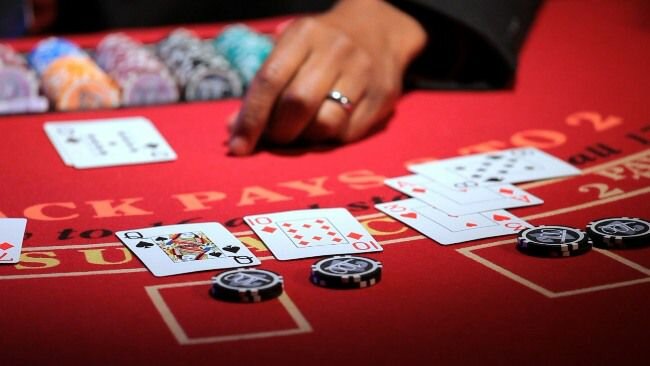
Beginner’s Guide to Blackjack: Rules, Strategy, and Mistakes to Avoid
TL;DR: Learn the goal (beat the dealer, do not bust), use a short strategy table, avoid 6:5 games and side bets, set a budget, and play only at safe, licensed sites. Small edges matter. Calm play wins time at the table.
The Two-Minute Walk From the Casino Door to the Felt
The room is loud. Chips click. Cards snap. You want to sit, but the table looks fast. Breathe. You need only a few core moves and a bit of table sense. In two minutes, you can feel at home.
Here is the plan. First, learn what the game asks from you. Then, use one small chart. After that, spot good rules and skip bad ones. We will also fix seven common errors. By the end, you can take a seat without fear and play with a cool head.
Blackjack on One Page
The goal is simple: make a hand that is closer to 21 than the dealer’s hand without going over. If you go over 21, you bust and lose. Aces count as 1 or 11. Face cards are 10. Other cards are their number.
Key terms you will see on the felt:
- Hit – take one more card.
- Stand – stop and keep your hand.
- Double – double your bet, take one card, then stand.
- Split – if you have a pair, make two hands.
- Surrender – give up the hand and get half your bet back (if the table allows it).
Each round starts with bets. The dealer gives two cards to each player and one up card (and one down card) to the dealer. You act first, then the dealer acts by fixed rules. If you want an official, plain list of actions and flow, check this official blackjack rules overview from a U.S. regulator.
Watch the pay table. A “blackjack” (Ace + 10-value card on the first two cards) should pay 3:2. Some tables pay 6:5. That looks small, but it hurts your odds a lot. Here’s a clear explainer of payouts in simple terms on blackjack payouts explained by Britannica.
Basic table manners help too. Keep your cards on the felt. Use clear hand signals for hit and stand. Place chips neatly. Do not touch your bet after the first deal. Ask the dealer when in doubt. They will help.
Quick Wins: Stand, Double, Split — When They Actually Help
You do not need to learn a big chart on day one. Start with three choices that move the needle most: when to stand, when to double, and when to split. These give fast gains with little brain load.
First, learn a few “always” and “never” rules. Always split A,A and 8,8. Never split 5,5 or 10,10. With 11, double if you can (unless the dealer shows an Ace in some games). With 10, double vs dealer 2–9. With 9, double vs dealer 3–6. If double is not allowed, hit instead. For a full map you can keep in your pocket, see a trusted blackjack basic strategy chart by Wizard of Odds.
Use quick notes in your head. Soft hands (A counted as 11) like A,7 play different from hard 17. Soft hands can take a hit with less risk. Hard 12 vs dealer 2 or 3 is tricky; hard 12 vs 4–6 is a stand. The point is not to win each hand. The point is to make the best choice on average, again and again.
A Beginner’s Quick Strategy Table (Print-Ready)
Here is a short table you can learn fast. It will not cover every edge case, but it will carry you through most seats. Note: table rules can change the perfect choice a bit; see the note after the table.
| Blackjack (Ace + 10 on first two cards) | Stand. Pays 3:2 on good tables (avoid 6:5). |
| A,A or 8,8 (pair) | Always split. |
| 5,5 or 10,10 (pair) | Never split. With 5,5 treat as 10; often double vs 2–9. |
| Total 11 vs dealer 2–10 | Double if allowed; else hit. |
| Total 10 vs dealer 2–9 | Double if allowed; else hit. |
| Total 9 vs dealer 3–6 | Double if allowed; else hit. |
| Hard 17 or more | Stand. |
| Hard 13–16 vs dealer 2–6 | Stand. |
| Hard 12 vs dealer 4–6 | Stand. |
| Hard total 5–11 (no soft Ace) | Hit (or double as above). |
| Soft A,2 to A,7 vs dealer 5–6 | Double if allowed; else hit. |
| Soft A,7 (A+7) vs dealer 2,7,8 | Stand vs 2,7,8; hit vs 9,10,A; double vs 3–6. |
| Surrender (if allowed) | 16 vs 9/10/A; 15 vs 10. |
| Insurance (dealer shows Ace) | Do not take it (see why below). |
Small rule shifts (how many decks, dealer hits soft 17 or not, late surrender, double after split, etc.) change the math a bit. If you like the numbers, this short guide to how rule changes affect the house edge is a good next step.
Table Rules Decoded: 3:2 vs 6:5, H17 vs S17, Decks, DAS, RSA, Late Surrender
Not all tables are the same. Some rules make the game fairer for you. Some make it worse.
- Blackjack 3:2 vs 6:5 – 3:2 is the classic, better pay. 6:5 raises the house edge by about 1–1.5% on its own. Avoid 6:5 if you can.
- H17 vs S17 – H17 means the dealer hits a soft 17. S17 means the dealer stands on soft 17. H17 is worse for you by ~0.2%.
- Decks – More decks, slightly higher house edge. Single deck can be best, but watch for bad add-on rules.
- DAS (Double After Split) – Good for you. It lets you double on split hands.
- RSA (Resplit Aces) – Also good, if allowed.
- Late Surrender – Good. It saves money on very weak spots.
Want to see the shift per rule with exact numbers? Here is a clean chart of house edge by rule variation from Wizard of Odds.
A Beginner’s Bankroll: How Much, What Limits, How Long
Pick a table you can afford. A simple rule: for a calm 1–2 hour session, bring at least 40–60 bets. For longer play, 80–100 bets feel safer. At a $10 table, that is $400–$1,000. If that feels high, choose a lower limit or play online with small stakes.
Set two stops: a loss stop and a win stop. For example, “I stop if I lose 30 bets” and “I lock up profit if I win 40 bets.” Keep your pace slow. You do not need to bet each shoe. Avoid bet “progressions” that chase losses. They feel smart, but the math does not care. For a short read on risk rules, see bankroll management basics.
Side Bets and Insurance: Candy With a Price Tag
Side bets look fun: Perfect Pairs, 21+3, Royal Match, and more. Many have a high house edge, often 5–10% or more. They can be okay as light fun, but they will drain your stack over time. Insurance is a side bet on the dealer’s blackjack when the dealer shows an Ace. It pays 2:1 if the down card is a 10. Most of the time, it is a bad deal. As a rule, skip it.
If you like to see why in numbers, the key idea is “expected value.” This short lesson on expected value shows how average results add up over time.
Live vs Online, and How Fairness Is Verified
Live tables and online tables play the same game, but the feel is not the same. Live play is slower and social. Online play is faster and quiet. Online you often get better rules, small stakes, and fast practice. Live dealer streams give you a “real table” feel from home, but still run on firm rules.
Safety matters. Good sites use random number generators (RNG) that are tested by third parties. Groups like independent RNG testing labs (eCOGRA) check fairness. Labs such as gaming labs certification standards (GLI) also test games and systems. In strong markets, regulators watch operators. The UK, for example, sets rules on fairness, funds, and ads; see how how regulators protect players at the UK Gambling Commission.
One more tip: always check that the site has a clear license note, support options, and fast KYC. If anything looks off, do not deposit.
Etiquette and Table Comfort
Blackjack has simple table habits. Buy in when the shoe ends, if the sign says “no mid-shoe entry.” Place your bet before the dealer starts the deal. Use hand signals: tap for hit, wave flat for stand, place one chip to the side to double, split fingers like a V for split. Do not hold the cards if they are dealt face up. Do not give advice to other players unless asked.
Do not blame others for how they play. There are no “hot” or “cold” seats you can prove. Over time, good choices beat myths. Be kind to the dealer, tip if you wish, and keep the game fun.
7 Fixes You Can Use Tonight
Most new players lose money on the same small errors. Fix these, and you cut waste at once.
- Playing 6:5 blackjack. It looks close to 3:2, but it is not. It adds a big edge for the house. If the sign says 6:5, thank the table and walk.
- Skipping doubles. Doubling is where much of your edge lives. When the chart says “double,” try to do it. If the table does not allow it, at least hit.
- Splitting 10s or 5s. It feels like “more hands!” but the math is bad. 10,10 is a made hand. 5,5 is a great double, not a split.
- Taking insurance. You bet on the dealer having a 10 in the hole. Most of the time that card is not a 10. Over many hands, you will lose on this bet.
- Playing soft hands like hard hands. A,7 is not 17 in the same way. You can hit soft hands without the same bust risk. Learn a few soft rules (see the table) and your results improve fast.
- Betting too big for your bankroll. If your buy-in is 20 bets, you may go broke fast just from normal swings. Aim for at least 40–60 bets for a calm session.
- Letting emotions drive choices. A bad beat hurts. Do not chase. Take a break, breathe, and come back later or tomorrow. Tilt is real; guard your mood.
A 7-Day Practice Plan
You can get sharp in one week with short, focused drills.
- Day 1: Learn card values. Say a card’s value out loud. Deal fake hands to yourself.
- Day 2: Memorize the four split rules: always A,A and 8,8; never 5,5 and 10,10.
- Day 3: Drill doubles: 11 vs 2–10; 10 vs 2–9; 9 vs 3–6.
- Day 4: Learn hard 12–16 vs dealer 2–6 (when to stand).
- Day 5: Learn soft A,2–A,7 basics (double vs 5–6; A,7 rules in the table).
- Day 6: Play 30 hands on a free trainer and record your tricky spots.
- Day 7: Review your notes. Make flash cards for hands you miss.
Card Counting in One Honest Paragraph
Card counting is a way to track the ratio of high to low cards left in the shoe. With skill and tight bankroll rules, a counter can gain a small edge. It is not illegal in most places, but casinos can ask you to stop or leave. It also takes long, calm practice and strict game selection. If you are just starting, master basic strategy first. For a fun read on the history, see the MIT blackjack team story.
Where to Play Safely
Pick sites that are licensed, tested, and clear on rules and support. If you want a short list of places with real reviews and simple pros/cons, you can read the full guide. Always check what market the site serves, what the payment rules are, and how fast support replies.
Mini Scenarios (Quick Checks)
- You have 10 vs dealer 9. Best move? Double if allowed; else hit.
- You have A,7 vs dealer 3. Best move? Double if allowed; else stand.
- You have 12 vs dealer 2. Best move? Hit.
- You have 16 vs dealer 10. Best move? Surrender if allowed; else hit.
- Dealer shows Ace and offers insurance. Best move? Say no.
FAQ
What’s the best way to learn basic strategy fast?
Start with the split rules and the three double rules. Add the hard 12–16 vs 2–6 stands. Then drill soft hands. Ten minutes a day for a week beats a long cram once.
Is blackjack luck or skill?
It is both. You cannot control the next card. You can control your choices. Good choices cut losses and raise wins over time. That is the skill part.
Should I ever take insurance?
As a new player, no. The odds do not support it in most shoes. Save your chips for strong doubles and good splits.
What bankroll do I need for $10 tables?
For a short, calm session, aim for $400–$600. For longer play, $800–$1,000. If that feels high, try a lower limit or play online with micro stakes.
Are online blackjack games fair?
On licensed sites, yes. Reputable platforms use tested RNGs and live dealer games with strict rules. Look for eCOGRA or GLI seals, and a license from a known regulator like the UKGC. You can read about lab tests at eCOGRA and GLI, and what regulators do at the UK Gambling Commission.
What’s the difference between H17 and S17?
H17 means the dealer hits soft 17; S17 means the dealer stands. H17 is worse for players. If you can choose, pick S17.
Is card counting illegal?
In most places, using your brain alone is not illegal. But casinos can refuse play. They can shuffle early or ask you to leave. Stay polite and follow house requests.
Responsible Play + Legal Note
Gambling should be fun, not a source of stress. Set limits on time and money. Never play to fix a bill or a loss. If you feel pressure or loss of control, seek help. In the U.S., see help for problem gambling. In the UK, see safer gambling advice. Industry-wide standards are listed by the American Gaming Association. Check your local laws: legal age is 18+ or 21+ by region. Play only on licensed platforms in your area.
One-Page Recap (Pin This)
- Goal: beat the dealer without busting. Aces are 1 or 11; face cards are 10.
- Always split A,A and 8,8. Never split 5,5 or 10,10.
- Double 11 vs 2–10; 10 vs 2–9; 9 vs 3–6 when allowed.
- Stand on hard 12 vs 4–6 and hard 13–16 vs 2–6; stand on 17+.
- Avoid 6:5 games. Seek S17, DAS, late surrender, fewer decks.
- Skip insurance and most side bets.
- Bring 40–60 bets for a short session; set loss/win stops.
- Practice 10 minutes a day; stay calm; walk when tired.
Note: This guide was reviewed for accuracy and clarity. Blackjack rules and offers can change by casino and by region. Check posted rules at the table before you play.